Metabolism
on-line - the virtual tutorial room
copyright © 2008 - 2015 David A Bender
Summary - why do we need to eat and how do we survive between meals?
Total energy expenditure for a 70 kg adult is between 8 - 12 MJ /day, depending on physical activity. Approximately 70% of this is required even at rest, when not performing physical activity.
What processes account for this resting energy expenditure?
Even at rest there is some work being performed by muscles - to maintain circulation and breathing and generally maintain muscle tone.
Sodium, potassium and calcium ions are transported across cell membranes and between intracellular compartments by active transport, which is energy requiring.
There is continual breakdown of tissue proteins and replacement synthesis - both processes are energy requiring.
Many enzyme catalysed reactions are endothermic and require an input of energy.
The pie chart below shows the percentage of resting energy expenditure for different functions

What is meant by the term Basal Metabolic Rate (BMR)?
BMR is the energy expenditure by the body when completely at rest, but awake, at a comfortable temperature and about 4 hours after a meal.
Why is it important for the subject to be awake, although completely at rest, for measurement of BMR?
Some people lower their metabolic rate and body temperature slightly when they are asleep. In other people there is an increase in metabolic rate, and an increase in heat output from the body, when they are asleep.
What is the mechanism for an increased metabolic rate when people are asleep?
This is the effect of activation of uncoupling proteins in muscle and brown adipose tissue. Some people, who do not gain weight readily respond to leptin and other hormones secreted by adipose tissue to increase energy expenditure, and so reduce adipose tissue reserves, when they are asleep. Other people, whose body temperature falls when they are asleep, are biologically more efficient, conserving their energy reserves. They are more likely to gain weight with a small excess of food intake over energy expenditure.
Why is it important for the subject to be at a comfortable temperature for measurement of BMR?
This is to ensure that energy is not being expended in either thermogenesis to compensate for a low external temperature or sweating and vasodilatation to lose excess heat from the body.
Why is it important that BMR is measured about 4 hours after a meal?
This is to ensure that energy is not being expended on synthesis and secretion of digestive enzymes, active transport for the absorption of the products of digestion and synthesis of body reserves of metabolic fuel. This is known as diet-induced thermogenesis, the increase in metabolic rate after a meal - there is more on this later in this exercise.
How can you measure BMR and energy expenditure in various activities?
The "gold standard" method is to measure heat output from the body in an insulated room that is maintained at a constant temperature by passing cold water through pipes and measuring the increase in temperature of the water. It is also possible to measure the energy expenditure in a limited number of activities (and for a limited time) in the same way.
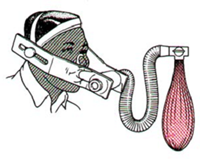 More usually,
BMR and energy expenditure in physical activity are measured by measuring oxygen
consumption.
More usually,
BMR and energy expenditure in physical activity are measured by measuring oxygen
consumption.
To first approximation there is an energy expenditure of 20 kJ for each litre of oxygen consumed.
This means that it is possible to measure energy expenditure in a wider range of activities, for a longer period, and under more or less normal conditions, rather than in the somewhat artificial conditions of a metabolic chamber.
How can you estimate the relative amounts of different fuels being metabolised?
By measuring the ratio of carbon dioxide formed : oxygen consumed (the respiratory quotient, RQ):
energy yield (kJ /g) |
oxygen consumed (L /g) |
carbon dioxide produced (L /g) |
RQ |
energy yield / |
|
| carbohydrate | 16 |
0.829 |
0.829 |
1.000 |
~20 |
| protein | 17 |
0.966 |
0.782 |
0.809 |
~20 |
| fat | 37 |
2.016 |
1.427 |
0.707 |
~20 |
Thus, an RQ near to 1 indicates that mainly carbohydrate is being oxidised, and RQ near 0.7 indicates that mainly fat is being oxidised.
How might you estimate the amount of protein being oxidised?
 Urea
is the end-product of metabolism of the amino groups of amino acids. The urinary
excretion of urea therefore reflects the amount of amino acids arising from
dietary protein or tissue proteins being metabolised.
Urea
is the end-product of metabolism of the amino groups of amino acids. The urinary
excretion of urea therefore reflects the amount of amino acids arising from
dietary protein or tissue proteins being metabolised.
How could you measure total energy expenditure over a period of several days?
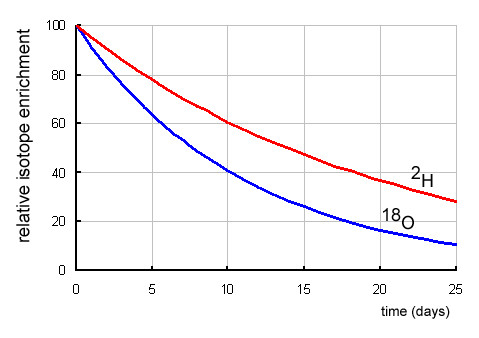 By
using dual isotopically labelled water (i.e. water containing both deuterium
(2H) and 18O, both of which are stable isotopes. The loss of the two labels
from any body fluid (most conveniently urine) is followed for a period of several
days or weeks after drinking a sample of the labelled water.
By
using dual isotopically labelled water (i.e. water containing both deuterium
(2H) and 18O, both of which are stable isotopes. The loss of the two labels
from any body fluid (most conveniently urine) is followed for a period of several
days or weeks after drinking a sample of the labelled water.
The deuterium label is lost from the body only in water.
By contrast, the oxygen label is lost from the body in both water and carbon dioxide, because of the rapid equilibrium between carbon dioxide and bicarbonate - all three atoms of oxygen in bicarbonate are equivalent and each is as likely as the others to end up in carbon dioxide or water:

From the difference in rate constants for the loss of the deuterium and hydrogen labels from body water it is possible to calculate the total amount of carbon dioxide produced over the period. Knowing the approximate mix of metabolic fuels consumes, it is then possible to calculate total energy expenditure in a non-invasive way that does not interfere with the subject's normal activities.
What is meant by the term Physical Activity Ratio (PAR)?
PAR is the energy expended in a given physical activity expressed as a multiple of the BMR. Very light activities have a PAR of between 1.0 - 1.4 times BMR; very heavy physical activity may have a PAR as high as 6 - 8 times BMR.
PAR is also known as MET - the Metabolic Equivalent of aTask.
Physical activity ratios in different types of activity are as follows:
| PAR 1.0 - 1.4 | Lying, standing or sitting at rest, e.g. watching TV, reading, writing, eating, playing cards and board games |
| PAR 1.5 - 1.8 | sitting: sewing, knitting, playing piano, driving standing: preparing vegetables, washing dishes, ironing, general office and laboratory work |
| PAR 1.9 - 2.4 | standing: mixed household chores, cooking, playing snooker or bowls |
| PAR 2.5 - 3.3 | standing: dressing, undressing, showering, making beds, vacuum cleaning walking: 3 - 4 km/h, playing cricket occupational: tailoring, shoemaking, electrical and machine tool industry, painting and decorating |
| PAR 3.4 - 4.4 | standing: mopping floors, gardening, cleaning windows, table tennis,
sailing walking: 4 - 6 km/h, playing golf occupational: motor vehicle repairs, carpentry and joinery, chemical industry, bricklaying |
| PAR 4.5 - 5.9 | standing: polishing furniture, chopping wood, heavy gardening, volley
ball walking: 6 - 7 km/h exercise: dancing, moderate swimming, gentle cycling, slow jogging occupational: labouring, hoeing, road construction, digging and shovelling, felling trees |
| PAR 6.0 - 7.9 | walking: uphill with load or cross-country, climbing stairs exercise: jogging, cycling, energetic swimming, skiing, tennis, football |
Classification of types of occupational work by PAR (average PAR through 8h working day, excluding leisure activities)
Light work PAR 1.7 professional, clerical and technical workers, administrative and managerial staff, sales representatives, housewives Moderate work PAR 2.2 for women,
2.7 for mensales staff, domestic service, students, transport workers, joiners, roofing workers Moderately heavy work PAR = 2.3 for women
3.0 for menmachine operators, labourers, agricultural workers, bricklaying, masonry Heavy work PAR= 2.8 for women
3.8 for menlabourers, agricultural workers, bricklaying, masonry where there is little or no mechanisation
What is meant by the term Physical Activity Level (PAL)?
PAL is the sum of the PAR for each activity during the day x fraction of 24 hours spent in that activity, expressed as multiple of BMR
What us meant by the term Diet Induced Thermogenesis (DIT)?
DIT is the increase in metabolic rate after a meal. It is the energy expenditure for synthesis and secretion of digestive enzymes, active transport for the absorption of the products of digestion and, most importantly, the synthesis of body reserves of metabolic fuel. Altogether it may represent 10 - 15% of the energy yield of a meal.
Apart from direct measurement, how would you go about estimating some-one's total energy expenditure (TEE)?
You could do this by estimating their BMR, which depends on gender, age and body weight from standard tables, such as that shown below (which is for reference only - you do not need to know the figures, just be aware that BMR:
is higher in men than in women of the same body weight
increases with increasing body weight
decreases with age even if body weight remains constant
| age | body weight (kg) |
||||
50 |
60 |
70 |
80 |
90 |
|
| males | |||||
| 10-17 | 6.38 |
7.11 |
7.84 |
8.58 |
9.31 |
| 18-29 | 6.04 |
6.68 |
7.32 |
7.96 |
8.60 |
| 30-59 | 6.10 |
6.58 |
7.07 |
7.55 |
8.04 |
| > 60 | 4.87 |
5.43 |
6.00 |
6.56 |
7.13 |
| females | |||||
| 10-17 | 5.67 |
6.18 |
6.69 |
7.20 |
7.71 |
| 18-29 | 5.16 |
5.77 |
6.39 |
7.00 |
7.62 |
| 30-59 | 5.29 |
5.65 |
6.02 |
6.38 |
6.75 |
| > 60 | 4.69 |
5.12 |
5.56 |
6.00 |
6.44 |
Then you need to estimate their physical activity. The easiest way to do this is to keep a diary of activities (see the list of PAR for different activities above) and the time spent in each activity, so that you can calculate their PAL, and make an approximation of their DIT.
TEE = PAL x BMR + DIT
Why do you think BMR is higher in men than in women of the same body weight?
 There is a gender difference in
body composition - women have higher reserves of adipose tissue than do men
of the same weight. This is because women have evolved to have adequate reserves
of adipose tissue to permit then to carry a pregnancy and lactation during a
time when food was scarce.
There is a gender difference in
body composition - women have higher reserves of adipose tissue than do men
of the same weight. This is because women have evolved to have adequate reserves
of adipose tissue to permit then to carry a pregnancy and lactation during a
time when food was scarce.
Adipose tissue is metabolically active, but considerably less so per gram of tissue than muscle or other lean tissues. This is because ~80% of the mass of adipose tissue is triacylglycerol rather than metabolically active cytosol.
Why do you think BMR falls with increasing age, even if body weight remains unchanged?
Again this is due to changes in body composition. There is a gradual loss of active muscle with increasing age, and the development of larger reserves of triacylglycerol between muscle fibres.
Click here for an exercise on estimating energy requirements from an activity diary
Although a desirable level of physical activity for cardiovascular fitness and general health is 1.7 x BMR, the average in developed countries is only 1.4 x BMR. This means that energy requirements during the day, when we are physically active, are only about 40% more than when we are asleep. This raises a problem. Most people eat 2 or 3 times a day. How can they ensure a supply of metabolic fuels and so survive between meals?
What are the main metabolic fuels available to tissues?
The main metabolic fuels are glucose, fatty acids (either as free (non-esterified) fatty acids in the circulation or triacylglycerol in plasma lipoproteins) and ketone bodies.
What proportion of energy intake should ideally come from carbohydrates, fats and proteins?
Ideally the diet should provide 55% of energy from carbohydrate, 30% from fat and 15% from protein. (Average western diets provide more fat than this, about 40%, and this is associated with obesity and increased risk of cardiovascular disease and cancer)
The figure of 15% of energy from protein is about 2 x higher than the requirement for protein (see later exercises), but it reflects the average intake of protein in developed countries. Since there is no hazard in consuming this amount of protein, and no advantage in reducing the intake, there is not considered to be any need to change average protein intakes.
The key public health target is to reduce fat intake (and especially saturated fat, see later exercises), and replace it with carbohydrate (and increase the proportion of carbohydrate coming from starches, while reducing that from sugars).