Metabolism
on-line - the virtual tutorial room
copyright © 2008 - 2015 David A Bender
Summary - why do we need to eat and how do we survive between meals?
Total energy expenditure for a 70 kg adult is between 8 - 12 MJ /day, depending on physical activity. Approximately 70% of this is required even at rest, when not performing physical activity.
What processes account for this resting energy expenditure?
Even at rest there is some work being performed by muscles - to maintain circulation and breathing and generally maintain muscle tone.
Sodium, potassium and calcium ions are transported across cell membranes and between intracellular compartments by active transport, which is energy requiring.
There is continual breakdown of tissue proteins and replacement synthesis - both processes are energy requiring.
Many enzyme catalysed reactions are endothermic and require an input of energy.
The pie chart below shows the percentage of resting energy expenditure for different functions

What is meant by the term Basal Metabolic Rate (BMR)?
BMR is the energy expenditure by the body when completely at rest, but awake, at a comfortable temperature and about 4 hours after a meal.
Why is it important for the subject to be awake, although completely at rest, for measurement of BMR?
Some people lower their metabolic rate and body temperature slightly when they are asleep. In other people there is an increase in metabolic rate, and an increase in heat output from the body, when they are asleep.
What is the mechanism for an increased metabolic rate when people are asleep?
This is the effect of activation of uncoupling proteins in muscle and brown adipose tissue. Some people, who do not gain weight readily respond to leptin and other hormones secreted by adipose tissue to increase energy expenditure, and so reduce adipose tissue reserves, when they are asleep. Other people, whose body temperature falls when they are asleep, are biologically more efficient, conserving their energy reserves. They are more likely to gain weight with a small excess of food intake over energy expenditure.
Why is it important for the subject to be at a comfortable temperature for measurement of BMR?
This is to ensure that energy is not being expended in either thermogenesis to compensate for a low external temperature or sweating and vasodilatation to lose excess heat from the body.
Why is it important that BMR is measured about 4 hours after a meal?
This is to ensure that energy is not being expended on synthesis and secretion of digestive enzymes, active transport for the absorption of the products of digestion and synthesis of body reserves of metabolic fuel. This is known as diet-induced thermogenesis, the increase in metabolic rate after a meal - there is more on this later in this exercise.
How can you measure BMR and energy expenditure in various activities?
The "gold standard" method is to measure heat output from the body in an insulated room that is maintained at a constant temperature by passing cold water through pipes and measuring the increase in temperature of the water. It is also possible to measure the energy expenditure in a limited number of activities (and for a limited time) in the same way.
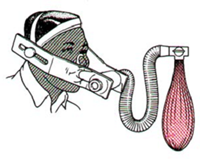 More usually,
BMR and energy expenditure in physical activity are measured by measuring oxygen
consumption.
More usually,
BMR and energy expenditure in physical activity are measured by measuring oxygen
consumption.
To first approximation there is an energy expenditure of 20 kJ for each litre of oxygen consumed.
This means that it is possible to measure energy expenditure in a wider range of activities, for a longer period, and under more or less normal conditions, rather than in the somewhat artificial conditions of a metabolic chamber.
How can you estimate the relative amounts of different fuels being metabolised?
By measuring the ratio of carbon dioxide formed : oxygen consumed (the respiratory quotient, RQ):
energy yield (kJ /g) |
oxygen consumed (L /g) |
carbon dioxide produced (L /g) |
RQ |
energy yield / |
|
| carbohydrate | 16 |
0.829 |
0.829 |
1.000 |
~20 |
| protein | 17 |
0.966 |
0.782 |
0.809 |
~20 |
| fat | 37 |
2.016 |
1.427 |
0.707 |
~20 |
Thus, an RQ near to 1 indicates that mainly carbohydrate is being oxidised, and RQ near 0.7 indicates that mainly fat is being oxidised.
How might you estimate the amount of protein being oxidised?
 Urea
is the end-product of metabolism of the amino groups of amino acids. The urinary
excretion of urea therefore reflects the amount of amino acids arising from
dietary protein or tissue proteins being metabolised.
Urea
is the end-product of metabolism of the amino groups of amino acids. The urinary
excretion of urea therefore reflects the amount of amino acids arising from
dietary protein or tissue proteins being metabolised.