Metabolism
on-line - the virtual tutorial room
copyright © 2008 - 2015 David A Bender
Starving to slim
EW is 26 years old. She weights 90 kg and is 1.52 m tall, and is about to undergo elective surgery.
What is her body mass index?
Body mass index (BMI) = weight in kg / (height in metres squared).
= 90 / (1.52 x 1.52) = 38.9
You would classify her as being obese
A desirable range of BMI is 20 - 25. If she is to achieve a BMI of 25, what should she weigh?
If BMI = weight / height-squared then weight = BMI x height-squared = 25 x (1.52 x 1.52) = 57 kg
If her target weight is 57 kg then she has to lose 33 kg.
The energy yield of adipose tissue can be calculated from the fact that it contains 80% triacylglycerol (at 37 kJ /gram) and 5% protein (at 17 kJ /gram). Therefore 100 g of adipose tissue yields:
from triacylglycerol: 80 x 37 = 2960 kJ
from protein: 5 x 17 = 85 kJ
total = 3045 kJ = 3.045 MJ / 100 g adipose tissue = 30 MJ / kg adipose tissue (rounding off)
Assuming that she has a total energy expenditure of 10 MJ /day, that all her weight loss will be adipose tissue, and that she starves totally (apart from drinking water), how long would it take her to lose 33 kg?
33 kg adipose tissue yields 33 x 30 MJ = 990 MJ
she requires 10 MJ / day, so it will take her 990 / 10 = 99 days to
lose 33 kg.
On the basis of these calculations she can lose 33 / 99 = 0.33 kg /day, or a maximum theoretically possible 2.3 kg / week by starving completely.
During the first week of her fast she actually lost 5 kg.
How is it possible for her to lose more than this theoretically maximum possible amount of weight?
You need to think about the structure of glycogen and compare the storage of carbohydrate (as glycogen) and triacylglycerol (in adipose tissue).
Glycogen is a branched polymer of glucose linked a(1-4), with branch points provided by a(1-6) links:


This highly branched structure of glycogen (consisting of very hydrophilic glucose monomers) traps a large amount of water. As glycogen reserves in liver and muscle are depleted in the early stages of fasting, there will be a considerable loss of water, and hence a loss of more weight than can be accounted for by the utilisation of adipose tissue reserves.
By contrast, triacylglycerol is stored in lipid droplets in adipose tissue cells, and 80% of the mass of adipocytes is triacylglycerol, with only a small amount of water in the cytosol.
Is it correct to assume that all of her weight loss will be adipose tissue?
No - The brain is largely reliant on a source of glucose, and red blood cells entirely so - neither can metabolise fatty acids. This means that there will have to be considerable catabolism of muscle (and other tissue) protein to provide amino acids for synthesis of glucose (gluconeogenesis).
For reasons that wil become apparent in a later exercise, fatty acids can never be used for gluconeogenesis. The glycerol from breakdown of triacylglycerol can be used for synthesis of glucose, but not nearly enough to meet the needs of the brain and red blood cells.
Do you think it is likely that she can survive for 99 days with no food, relying on her (ample) reserves of triacylglycerol in adipose tissue?
Although the triacylglycerol in her adipose tissue would be more than enough to meet her energy needs, the loss of protein to provide a substrate for gluconeogenesis means that she would be unlikely to survive starvation for as long as 99 days - some protein can be lost from tissues without causing any significant harm, but eventually there would be significant losses of essential tissue proteins, and she would die.
Also, she would need a source of vitamins and minerals to replace those lost in metabolic turnover - with no dietary source, she would start to show signs of vitamin B1 deficiency within a week or so of starvation.
The question we now have to ask is why EW needs a source of metabolic fuel for energy.
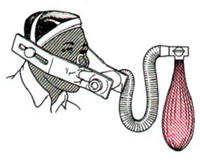 We
can measure energy expenditure from the consumption of oxygen. A number of studies
of heat output from the body and oxygen consumption have shown that (regardless
of the mixture of substrates being oxidised), consumption of 1 litre of oxygen
is equivalent to energy expenditure of 20 kJ.
We
can measure energy expenditure from the consumption of oxygen. A number of studies
of heat output from the body and oxygen consumption have shown that (regardless
of the mixture of substrates being oxidised), consumption of 1 litre of oxygen
is equivalent to energy expenditure of 20 kJ.
Obviously, physical activity will account for some of her energy need. However, her oxygen consumption was measured when she was lying down completely at rest.