Metabolism
on-line - the virtual tutorial room
copyright © 2008 - 2015 David A Bender
A respiratory physiology practical class - and beyond
PN had a physiology practical class on respiratory physiology, and the first exercise involved measuring the relative amounts of nitrogen, oxygen, and carbon dioxide in inhaled and exhaled air. The results were as follows:
inhaled |
exhaled |
|
| nitrogen | 78% |
78% |
| oxygen | 21% |
17% |
| carbon dioxide | 0.04% |
4.0% |
How and where has the oxygen been consumed?
Where has the carbon dioxide come from?
The oxygen has been consumed in the oxidation of metabolic fuels, mainly glucose and fatty acids, in various tissues, and the carbon dioxide is the product of that oxidation.
What are the three ways in which an organic compound may be oxidised?
removal of hydrogen
removal of electrons
addition of oxygen
What is the most common way in which metabolites are oxidised?
By removal of hydrogen onto an intermediate hydrogen carrier (or coenzyme), either NAD (nicotinamide adenine dinucleotide) or a flavin. See the exercise on overheating after overdosing on E later on for more on these coenzymes.
During the practical class it was also noticed that the exhaled air contained considerably more water vapour than inhaled air. Just over 1 mL more water was collected from exhaled air per minute than was present in the air in the laboratory.
This led to a separate experiment in which PN and several friends measured their intake of fluids, the water content of their food and the volume of urine passed each day for three days.
How would you measure the water content of foods eaten?
You could "cheat" by weighing the foods eaten and using food composition tables, but a more precise method would be to weight each food served, then take a small weighed sample and dry it to constant weight in an oven at 100°C. The difference in weight is due to material that is volatile at 100°C - i.e. water.
Once each day they each spent an hour in a metabolic chamber to measure the amount of water lost from their bodies in sweat and on their breath.
How do you think this could be achieved?
A metabolic chamber is a sealed room. There is an inlet for air from the laboratory, and air is pumped out of the chamber at a constant known through a condenser (which condenses water vapour to liquid water, which can then be measured). It is easy to measure the water content of the air in the laboratory by similarly using a condenser through which air is pumped at a constant known rate.
The air entering the chamber, and that leaving can also be sampled for measurement of oxygen an carbon dioxide, and heat output from the body can be measured by circulating cold water through pipes in the walls at such a rate as to maintain a constant temperature in the chamber. The increase in temperature of this cooling water then allows calculation of heat output in the chamber. You will come across use of such metabolic chambers to measure energy expenditure in later exercises.
Rather than collect their faeces to determine the water content in this experiment, they used a literature average figure - an adult man loses about 100 mL of water in faeces each day.
At the end of the experiment they drew up a table of their average daily fluid balance - the results were as follows:
| intake | |
fluids consumed |
1950 mL |
water in foods |
700 mL |
total intake |
2650 mL |
| output | |
urine |
1400 mL |
sweat and exhaled |
1500 mL |
faeces (estimated) |
100 mL |
total output |
3000 mL |
How is it possible for them to have lost 350 mL of water more than they consumed each day?
The end products of oxidation of metabolic fuels (mainly fatty acids and glucose) are carbon dioxide and water. This is what is known as metabolic water - water produced by the oxidation of metabolic fuels.
What are the equations for the total oxidation of glucose (C6H12O6) and the fatty acid palmitate (C15H31COOH) ?
for glucose:
C6H12O6 + 6 O2 = 6 CO2 + 6 H2O
for palmitate:
C15H31COOH + 23 O2 = 16 CO2 + 16 H2O
 At
this stage PN visits a friend who is studying for a PhD in the Department of
Medicine. Her project involves the control of metabolism in isolated liver cells
from normal and diabetic rats.
At
this stage PN visits a friend who is studying for a PhD in the Department of
Medicine. Her project involves the control of metabolism in isolated liver cells
from normal and diabetic rats.
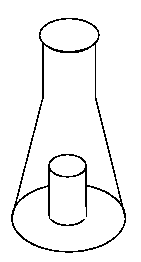
In one experiment she incubated the cells in stoppered vessels with an atmosphere containing the stable isotope of oxygen, 18O.
The cells were incubated in the outer compartment of the flask. At the end of the incubation an alkaline solution was injected through the stopper into the centre well, and a non-volatile acid (trichloroacetic acid) was injected into the outer compartment, to stop the reaction and drive off carbon dioxide, which was absorbed by the alkali in the centre well.The water in the incubation mixture was then micro-distilled the water into a separate vessel. This allows measurement of 18O in both carbon dioxide and water.
In one set of incubations the cells were provided with glucose as their substrate, and in the other with palmitate
She found that she had 18O labelled water, but no label in carbon dioxide in either set of incubations.