Metabolism
on-line - the virtual tutorial room
copyright © 2008 - 2015 David A Bender
An early morning jog
JBJ normally jogs for an hour before breakfast. One morning he measured his oxygen consumption and carbon dioxide production for 10 minutes while he was in bed drinking a cup of unsweetened black coffee, again during his jog, and for 10 minutes quarter of an hour after a breakfast of cereal with milk, a boiled egg, toast and butter.
The main metabolic fuels are fatty acids and glucose.
How much carbon dioxide will be produced, and how much oxygen will be consumed, by the total oxidation to carbon dioxide and water of:
the fatty acid palmitate (C15H31COOH)
glucose (C6H12O6)
What is the ratio of carbon dioxide produced / oxygen consumed for each?
for palmitate:
C15H31COOH + 23 O2 = 16 CO2 + 16 H2O
ratio CO2 / O2 = 0.7
for glucose:
C6H12O6 + 6 O2 = 6 CO2 + 6 H2O
ratio CO2 / O2 = 1.0
How can you use this information to determine the approximate mixture of metabolic fuels being oxidised?
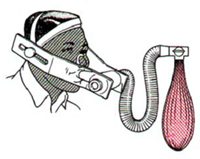 By
measuring the consumption of oxygen and production of carbon dioxide, using
a Douglas bag or similar device to sample inhaled and exhaled air. This ratio
of carbon dioxide produced / oxygen consumed is the respiratory quotient (RQ).
By
measuring the consumption of oxygen and production of carbon dioxide, using
a Douglas bag or similar device to sample inhaled and exhaled air. This ratio
of carbon dioxide produced / oxygen consumed is the respiratory quotient (RQ).
When mainly fatty acids are being metabolised the RQ is near to 0.707;
when
mainly glucose is being metabolised the RQ is close to 1.0.
For the present exercise you can assume that only fat and glucose are being metabolised, but normally some amino acids arising from protein are also metabolised as metabolic fuel. The RQ is for protein oxidation is 0.8. You will see in later exercises that it is possible to estimate the amount of protein being oxidised by measuring the urinary excretion of urea, the main product of nitrogen metabolism.
He measured his RQ three times; the results he obtained were as follows:
RQ sitting up in bed = 0.8
average RQ while jogging = 0.71
RQ after breakfast = 0.98
What are the main fuels being metabolised at each of these times?
When fat is being metabolised, RQ=0.7
When glucose is being metabolised, RQ = 1.0
Therefore:
RQ = 0.8 suggests approximately equal amounts of fat and carbohydrate are being metabolised after an overnight fast
RQ = 0.71 suggests mainly fat is being metabolised in jogging after an overnight fast
RQ = 0.98 suggests mainly carbohydrate is being metabolised after breakfast
He also had blood samples taken before he went jogging, when he returned and 15 minutes after breakfast. Unfortunately, although he labelled the blood tubes, his research assistant in the laboratory mixed them up, and did not know which sample was which. The results obtained were:
glucose (mmol /L) |
free fatty acids (mmol
/L) |
|
| sample 1 | 6.5 |
0.1 |
| sample 2 | 4.5 |
0.8 |
| sample 3 | 3.5 |
2.4 |