Metabolism
on-line - the virtual tutorial room
copyright © 2008 - 2015 David A Bender
An unconscious child with keto-acidosis and a skin rash

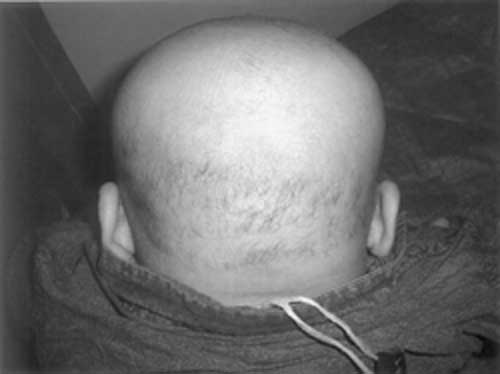 Barry
is the second child of parents who are first cousins; his brother is 5 years
old, fit and healthy. He was born at full term after an uneventful pregnancy,
weighing 3.4 kg (the 50th centile), and developed normally until he was 6 months
old, after when he showed some retardation of development. He also developed
a fine scaly skin rash about this time, and his hair, which had been normal,
became thin and sparse.
Barry
is the second child of parents who are first cousins; his brother is 5 years
old, fit and healthy. He was born at full term after an uneventful pregnancy,
weighing 3.4 kg (the 50th centile), and developed normally until he was 6 months
old, after when he showed some retardation of development. He also developed
a fine scaly skin rash about this time, and his hair, which had been normal,
became thin and sparse.
At 9 months of age he was admitted to UCL Hospital in a coma; emergency clinical
chemistry results on a plasma sample were as follows:
Barry |
Reference range |
|
| pH | 6.9 |
7.35 - 7.45 |
| Bicarbonate, mmol /L | 2.0 |
21 - 25 |
| Ketone bodies, mmol /L | 21 |
1 - 2.5 |
| Lactate, mmol /L | 7.3 |
0.5 - 2.2 |
| Pyruvate, mmol /L | 0.31 |
< 0.15 |
| Glucose, mmol /L | 3.3 |
3.5 - 5.5 |
What treatment should he be given in the Emergency Room?
His immediate problem is severe acidosis, so the most appropriate emergency treatment would be intravenous infusion of bicarbonate to permit respiratory compensation for the acidosis by exhaling carbon dioxide, so shifting the bicarbonate equilibrium to the right:.

He regained consciousness rapidly. Over the next few days he continued to respire rapidly, and even after a meal he excreted ketone bodies in his urine. His plasma glucose remained in the low normal range, and his plasma insulin was normal both in the fasting state and in response to an oral load of 50g of glucose /kg body weight.