Metabolism
on-line - the virtual tutorial room
copyright © 2008 - 2015 David A Bender
Fats and oils - are all fats the same?
Why do we need fat in the diet?
The main reason that there is a need for fat in the diet is that on a very low fat diet, providing less than about 10% of energy intake, it is difficult to eat a large enough bulk of food to meet energy requirements. Fat provides 37 kJ /gram, compared with 16 kJ /gram from carbohydrate and 17 kJ /gram from protein. In addition, carbohydrates and proteins in foods are associated with a considerable amount of water, while high-fat foods contain much less, and many carbohydrate-rich foods are also sources of non-starch polysaccharides, which add to the bulk of the food without providing a significant amount of energy.
We can add to this a number of other reasons:
Vitamins A, D, E and K, as well as carotenes and other lipid-soluble compounds are absorbed dissolved in dietary fat, and indeed fatty foods are the main sources of these nutrients.
Much of the flavour of many foods is contained in the fat.
Fat lubricates the food in the mouth, and makes chewing and swallowing easier.
Two families of polyunsaturated fatty acids cannot be synthesised in the body, and are required as precursors for the synthesis of prostaglandins and related compounds.
Conversely, there is a considerable body of evidence that excessively high intakes of fat, around 40% of energy or more, as was typical of western diets towards the end of the 20th century, are associated with a significantly increased risk of developing chronic non-communicable diseases - the so-called diseases of affluence, including:
atherosclerosis and coronary heart disease
hypertension and stroke
obesity and the metabolic syndrome, leading to the development of type II diabetes mellitus
Why do you think that a high fat diet is a significant contributor to the development of obesity?
Carbohydrates and proteins in foods are associated with a considerable amount of water, while high-fat foods contain much less. Many carbohydrate-rich foods are also sources of non-starch polysaccharides, which add to the bulk of the food without providing a significant amount of energy. This means that it is easier to consume more of a high-fat food than a low-fat food. Since fat provides 37 kJ /gram, compared with 16 kJ /gram from carbohydrate and 17 kJ /gram from protein, it is easy to see why a high fat diet contributes to the development of obesity.
The consensus that has developed over the last 40 - 50 years is that fat should provide no more than about 30% of energy, and intake of carbohydrates (and especially starches) should be increased from around 43% of energy intake to 55 - 57%.
As can be seen from the pie graphs below, this reduction in fat intake should be at the expense of saturated fats:

This leads us to consider the different types of fat in the diet.
We can divide the physiologically, nutritionally and metabolically important lipids into four groups:
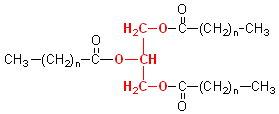
Triacylglycerols (sometimes known as triglycerides), in which three fatty acids are esterified to the 3-carbon alcohol glycerol. These are the oils and fats in the diet which provide 30 - 45% of average energy intake
Phospholipids, in which glycerol is esterified to two fatty acids, with a hydrophilic group esterified to carbon-3 by a phosphodiester bond. Phospholipids are major constituents of cell membranes, and also have an important role on lipid digestion and absorption.

Cholesterol and other sterols, including very small amounts of steroid hormones that are synthesised from cholesterol. Chemically sterols are completely different from triacylglycerols and phospholipids, and are not a source of metabolic fuel. You will consider the importance of dietary cholesterol in a later exercise.
A variety of other compounds that are soluble in lipid but not water, including vitamins A, D, E and K, as well as carotenes.
What is the difference between an oil and a fat?
Both are triacylglycerol, although they may contain other compounds, including phospholipids, fat-soluble vitamins and sterols. The only real difference is that fats are solid at room temperature, while oils are liquids.