Metabolism
on-line - the virtual tutorial room
copyright © 2008 - 2015 David A Bender
Children with fatty diarrhoea
LD was referred to the Great Ormond Street Hospital for Sick Children when he was 2½ years old by his GP, who wrote
"He has always had very peculiar greasy stools. The greasy part of the stools is always yellow or orange in colour and tends to separate from the rest of the motion. It floats on water; solidifies like flakes on cold water or like drops of oil on hot water. It tends to seep through his clothes. His bowel habit is regular, one or two motions daily. His development is normal for his age."
His weight and height were also normal for his age.
(From Sheldon W, Arch Dis Childhood 39: 268 1964)
 Normally,
about 2 hours after a moderately fat-rich meal a plasma sample is milky due
to the presence of chylomicrons, as shown in the sample on the right of the
picture. Chylomicrons are relatively large plasma lipoproteins - droplets of
triacylglycerol emulsified by surface proteins, unesterified cholesterol and
phospholipids. They have a diameter of 0.1 - 1 µm, which is large enough
to scatter light, hence the milky appearance of the plasma. Over a period of
2 - 3 hours the plasma becomes clear again, as chylomicrons are cleared from
the circulation, as shown in the sample on the left of the picture.
Normally,
about 2 hours after a moderately fat-rich meal a plasma sample is milky due
to the presence of chylomicrons, as shown in the sample on the right of the
picture. Chylomicrons are relatively large plasma lipoproteins - droplets of
triacylglycerol emulsified by surface proteins, unesterified cholesterol and
phospholipids. They have a diameter of 0.1 - 1 µm, which is large enough
to scatter light, hence the milky appearance of the plasma. Over a period of
2 - 3 hours the plasma becomes clear again, as chylomicrons are cleared from
the circulation, as shown in the sample on the left of the picture.
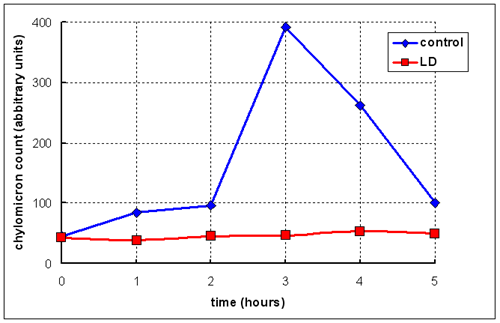
The graph below shows the formation and clearance of chylomicrons in LD and a control subject after a moderately high fat meal:
(From Sheldon W, Arch Dis Childhood 39: 268 1964)
What conclusions can you draw from these results?
Although LD has some chylomicrons in his circulation, there is no increase after a meal, suggesting either that he cannot absorb fat from the meal or that he has an impaired ability to form chylomicrons.
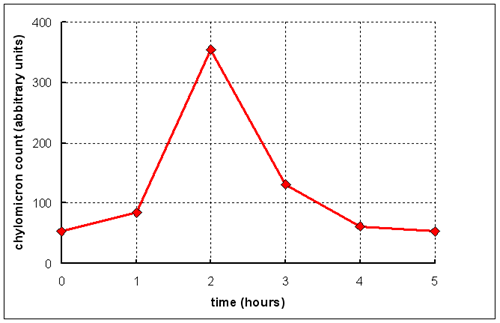
In the next experiment LD was given an intraduodenal infusion of highly emulsified fat, with droplets of the order of 4 - 6 nm in diameter. The results are shown below
:
What conclusions can you draw from these results?
It seems that LD can absorb fat and form chylomicrons if he is provided with highly emulsified fat. This suggests that his problem lies in the emulsification of fat into small enough droplets to be absorbed.
We now need to consider what factors are involved in the emulsification of dietary fat into droplets small enough to be absorbed.
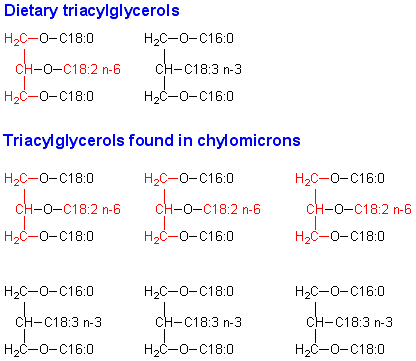
In the following experiment volunteers were fed a meal containing two synthetic triacylglycerols:
One consisted of C18:0 esterified to carbons-1 and -3, and C18:2 n-6 esterified to carbon-2. Both the glycerol and the C18:2 n-6 in this triacylglycerol were labelled with 13C.
The other consisted of C16:0 esterified to carbons-1 and -3, and C18:3 n-3 esterified to carbon-2. This triacylglycerol was unlabelled.
Three hours after the meal blood samples were taken and chylomicrons were isolated. Their triacylglycerol was analysed by gas chromatography and mass spectrometry, when the results shown below were obtained. Red shows the 13C labelled compounds.
What conclusions can you draw from these results?
There has obviously been exchange of fatty acids between carbons-1 and -3 of the two triacylglycerols, since both C16:0 and C18:0 occur in both the labelled and unlabelled triacylglycerols.
There has not been any significant exchange of the fatty acid at carbon-2 of either triacylglycerol, since [13C]C18:2 n-6 is still only associated with the [13C]glycerol, and unlabelled C18:3 n-3 is still only associated with the unlabelled glycerol.
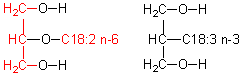
This suggests that the dietary triacylglycerol has undergone partial hydrolysis to remove the fatty acids esterified at carbons-1 and -3, leaving the 2-monoacylglycerols and non-esterified fatty acids.
If you aspirated a sample of jejunal contents from someone who had recently eaten a moderately fat-rich meal, how could you follow the digestion of triacylglycerol, and what would you expect to observe?
You could follow the digestion of triacylglycerol by gas chromatography, measuring the disappearance of triacylglycerol and the appearance of non-esterified fatty acids.
As triacylglycerol disappears, the resulting non-esterified fatty acids, diacylglycerol and monoacylglycerol, as well as phospholipids present in the dietary lipid and bile salts secreted by the gall bladder increasingly emulsify the lipid into smaller and smaller droplets.