Metabolism
on-line - the virtual tutorial room
copyright © 2008 - 2015 David A Bender
Muscle weakness and hypoketotic coma on fasting
TFP is a 3 year old girl who was admitted to the Emergency Department of her local hospital in a coma after two days when she had a fever and had been refusing food. She has a history of muscle weakness, and at the time of her admission her muscle tone was very poor - she was described as being "floppy". A blood sample taken on admission gave the following results:
TFP |
reference range (after overnight fast) |
|
| glucose (mmol /L) | 2.1 mmol /L |
3.5 - 5.5 |
| non-esterified fatty acids (mmol /L) | 2.5 mmol /L |
0.8 - 1.4 |
| ketone bodies (mmol /L) | not detectable |
1.0 - 2.5 |
| pH | 7.40 |
7.35 - 7.45 |
| bicarbonate | 23 |
21 - 25 |
| insulin (mU /L) | 3.5 |
4 - 8 |
What do you think was the cause of her coma?
She is profoundly hypoglycaemic, and this is the immediate cause of her coma - there is no evidence of acidosis, and her plasma insulin is appropriate for her hypoglycaemia (i.e. there is no evidence to suggest that her hypoglycaemia is caused by excess insulin secretion).
What is interesting is that she has a high plasma concentration of non-esterified fatty acids, but no ketone bodies are detectable. This suggests a possible defect in either the synthesis of ketone bodies or the oxidation of fatty acids. Her history of muscle weakness suggests that her underlying problem may be an inability to oxidise fatty acids, which form a major fuel for skeletal muscle. (See also the problem on Muscle weakness, heart failure and profound hypoglycaemia in a young girl ).
She recovered after an intravenous infusion of glucose, although her muscle tone and muscle strength were still poor. Again this is suggestive of a defect in fatty acid oxidation.
The pathway of fatty acid oxidation was elucidated at the beginning of the 20th century, although it was not until the middle of the century that the early deductions were confirmed experimentally.
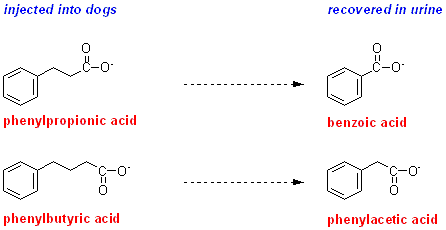
In 1904 Knoop reported the results of injecting dogs with two compounds: phenylpropionic acid and phenylbutyric acid. These are both (very) short chain fatty acids, with a phenyl group in place of the terminal methyl group. Phenylpropionic acid is a phenyl-labelled odd-carbon fatty acid ( 3-carbons), while phenylbutyric acid is a phenyl-labelled even-carbon fatty acid (4 carbons).
The end-products of oxidation of these two fatty acids were excreted as glycine and glucuronic acid conjugates; hydrolysis of the conjugates with hydrochloric acid showed that:
phenylpropionic acid was excreted as benzoic acid conjugates
phenylbutyric acid was excreted as phenylacetic acid conjugates