Metabolism
on-line - the virtual tutorial room
copyright © 2008 - 2015 David A Bender
Not an ounce of fat on her - and extreme emaciation in patient with advanced cancer
TGL is a 20 year old woman; she appears to be very muscular, with little or no subcutaneous adipose tissue and under-developed breasts. Over the last few years her abdomen has become more protuberant, and her liver is palpably enlarged. Blood tests revealed significant fasting hypertriglyceridaemia (plasma concentration of triacylglycerol 450 - 520 mmol /L on various occasions compared with a desirable range < 1.7 mmol /L). CAT scanning shows that she has very little subcutaneous or intra-abdominal adipose tissue.
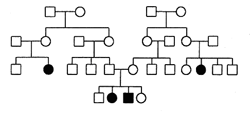 She was
born at term after an unremarkable pregnancy, but even at birth she appeared
abnormally muscular, with very little subcutaneous adipose tissue. Her younger
brother is similarly affected, as are two distant cousins.
She was
born at term after an unremarkable pregnancy, but even at birth she appeared
abnormally muscular, with very little subcutaneous adipose tissue. Her younger
brother is similarly affected, as are two distant cousins.
What conclusions can you draw from her pedigree?
This is almost certainly a genetic condition, with an autosomal recessive pattern of inheritance.
If isolated adipocytes are incubated with fatty acids, they only synthesise triacylglycerol if they are also provided with glucose.
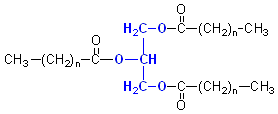
What is the most likely metabolite of glucose that will be the source of glycerol for triacylglycerol synthesis?
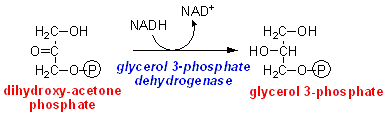
The most likely source of glycerol will be glycerol 3-phosphate, which arises as a result of the reduction of dihydroxyacetone phosphate, an intermediate in glycolysis.
How do you think fatty acids are "activated" in order to be esterified to glycerol 3-phosphate?
Remember that fatty acids are never in free solution in cells; they are always esterified to either CoA or carnitine. Fatty acyl carnitine is formed only to transport fatty acids into the mitochondrion for beta-oxidation (see the exercise on Muscle weakness, heart failure and profound hypoglycaemia in a young girl).

This means that fatty acids are activated for triacylglycerol synthesis by esterification with CoA.