Metabolism
on-line - the virtual tutorial room
copyright © 2008 - 2015 David A Bender
Was she murdered by insulin injection?
Mrs PI collapsed in a coma and was taken to the local hospital.
The results of blood tests were as follows:
Mrs PI |
reference range in fasting |
|
| glucose (mmol /L) | 1.2 |
3 - 5 |
| non-esterified fatty acids (µmol /L) | 190 |
700 - 900 |
| ketone bodies (µmol /L) | not detectable |
50 - 300 |
What do you think is the cause of Mrs PI's coma, and what is the likely cause?
She is profoundly hypoglycaemic. Like Ms CG in the exercise on Two diabetic patients in coma, this is probably the result of excessive insulin, either injected or the result of an insulin-secreting tumour of the pancreas (an insulinoma), since non-esterified fatty acids and ketone bodies are inappropriately low for someone who is so hypoglycaemic.
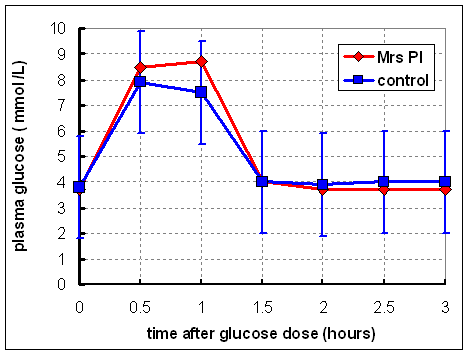 She was
kept in hospital for several days, appeared to be well, and was given an oral
glucose tolerance test (1 g of glucose /kg body weight). Plasma glucose was
measured over 3 hours. The results are shown on the right.
She was
kept in hospital for several days, appeared to be well, and was given an oral
glucose tolerance test (1 g of glucose /kg body weight). Plasma glucose was
measured over 3 hours. The results are shown on the right.
What conclusions can you draw from these results?
She is obviously not diabetic - at all times after the test dose of glucose her plasma glucose is within the norma range (shown by the error bars on the control curve).
Since she was now well, she returned home. On a number of occasions over the next few weeks she again collapsed in a coma, and was treated by glucose infusion, when she recovered consciousness.
She was known to drink heavily (several large gin-and-tonics each evening, and sometimes more). Her husband said that often she drank her pre-dinner gin-and-tonics, but then did not eat her meal.
How might drinking gin-and-tonic lead to hypoglycaemia?
The small amount of sugar in the tonic water causes insulin secretion, then the alcohol inhibits gluconeogenesis and glycogenolysis, so prolonging the hypoglycaemic action of the insulin. (This is how a small drink before dinner stimulates appetite, by causing mild hypoglycaemia).
One night she again fell into a coma, and this time died shortly after arriving at the hospital. A blood sample was taken before she died, and again showed that she was profoundly hypoglycaemic, with low non-esterified fatty acids and no detectable ketone bodies. Her blood alcohol was 75 mg /100 mL - just below the legal limit for driving.
Her plasma insulin was also measured, and was found to be extremely high - 2000 mU /L.