Metabolism
on-line - the virtual tutorial room
copyright © 2008 - 2015 David A Bender
Fasting hypoglycaemia in an infant - and poor exercise tolerance in two brothers
LR is a 16 month old baby, who was born at term after an uneventful pregnancy. Until she was 15 months old she had been fed every 3 - 4 hours, and never slept though the night, but woke every 3 - 4 hours, demanding to be fed.
At 15 months of age she slept through the night for the first time, and was found at 6 am in a generalised tonic-clonic seizure, which might suggest epilepsy. On admission to hospital a blood sample was taken; her plasma glucose was 1.5 mmol /L (the reference range for a fasting infant is 3.9 - 6.1 mmol /L), and a urine dipstick test showed the presence of a high concentration of ketone bodies.
What is the most likely cause of her seizure?
Almost certainly the very low plasma concentration of glucose. After a normal overnight fast her plasma glucose is as low as might be expected after several days of starvation, and you would not expect a very high level of ketone bodies in the urine after an overnight fast.
One possible cause of her abnormally low fasting plasma glucose would be an excessive and inappropriate secretion of insulin, but when her plasma insulin was measured it was at an appropriate level for her plasma glucose concentration in both the fed and fasting states.
She suffered a further seizure a few weeks later, again when she had slept through the night, and had not woken demanding to be fed.
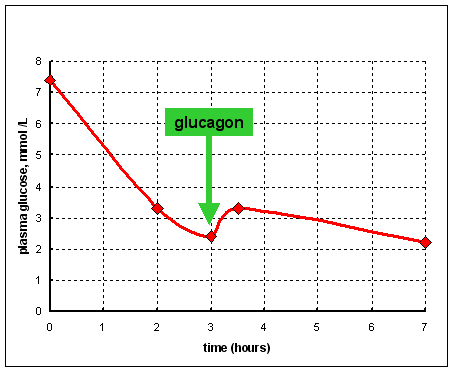 Her blood
glucose and lactate were measured at intervals for 7 hours after feeding, and
for a further 2.5 hours after breakfast. After 3 hours of fasting she was given
0.36 mg of glucagon intravenously.
Her blood
glucose and lactate were measured at intervals for 7 hours after feeding, and
for a further 2.5 hours after breakfast. After 3 hours of fasting she was given
0.36 mg of glucagon intravenously.
The results in the fasting state are shown on the right (from data reported by Rutledge SL et al. Pediatrics 108 495-7 2001).