Metabolism
on-line - the virtual tutorial room
copyright © 2008 - 2015 David A Bender
Experiments on glucose metabolism
So far, from various studies we have seen that (anaerobic) glucose metabolism leads to the production of 2 mol of lactate and 2 mol of ATP per mol of glucose consumed; the process also requires ATP and inorganic phosphate. The amount of glucose consumed, and of lactate formed, depends on the amount of ADP provided.
For the following studies, chicken breast muscle was homogenised in phosphate buffer at pH 7.4, then subjected to high speed centrifugation to remove cell debris, nuclei and mitochondria. The supernatant fraction (essentially cytosol, but also containing ribosomes and microsomes, was then dialysed against four changes of buffer to remove any endogenous substrates and other low molecular weight compounds. Each incubation in the following sets of experiments contained the dialysed homogenate from 1 g of fresh muscle tissue.
Experiments were conducted incubating this preparation with one of:
[14C-U]glucose at a specific activity of 1 µCi /mmol
[32P]ATP at a specific activity of 1 µCi /mmol
[32P]inorganic phosphate at a specific activity of 1 µCi /mmol
In the first set of experiments, incubations contained:
200 µmol glucose
200 µmol ATP
200 µmol ADP
200 µmol sodium phosphate
After incubation at 30C for 30 min, incubations were stopped by adding trichloroacetic acid to denature proteins, centrifuged and the supernatant was neutralised with sodium hydroxide. Aliquots of the supernatant were then subjected to high pressure liquid chromatography to measure both the amounts of various metabolites present and and the radioactivity in each. The results are shown as total amount of each metabolite and the specific radioactivity (µCi / mmol) - mean values ± sd from 3 x replicate incubations.
The following results were obtained:
metabolite |
amount |
specific radioactivity
(µCi /mmol) |
|||
µmol |
from [14C-U]glucose |
from [32P]ATP |
from [32P] inorganic phosphate |
||
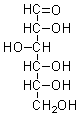 |
glucose |
100 ± 5 |
0.99 ± 0.02 |
- |
- |
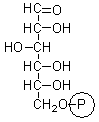 |
glucose 6-phosphate |
3.2 ± 0.4 |
0.98 ± 0.03 |
0.99 ± 0.03 |
0 |
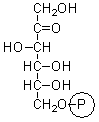 |
fructose 6-phosphate |
2.5 ± 0.3 |
0.99 ± 0.03 |
0.98 ± 0.03 |
0 |
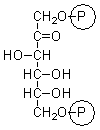 |
fructose 1,6-bisphosphate |
3.3 ±
0.7 |
0.99 ± 0.02 |
1.99 ± 0.04 |
0 |
 |
glyceraldehyde 3-phosphate |
94 ± 1.2 |
0.48 ± 0.03 |
0.99 ± 0.02 |
0 |
 |
dihydroxyacetone phosphate |
98 ± 1.4 |
0.49 ± 0.02 |
1 |
0 |
ATP |
0 |
- |
- |
- |
|
ADP |
248 ± 5 |
- |
0 |
0 |
|
There was no detectable formation of lactate.
What conclusions can you draw from these results?
It is difficult to explain at this stage why there was no formation of lactate or ATP. Indeed, all of the ATP seems to have been converted to ADP, whereas in previous studies we have seen phosphorylation of ADP to ATP associated with glucose metabolism.
It is obvious from these results that glucose has been phosphorylated to glucose 6-phosphate; it then seems likely that glucose 6-phosphate has been isomerised to fructose 6-phosphate. Fructose 6-phosphate has then been phosphorylated to fructose 1,6-bisphosphate, and it looks as is fructose 1,6-bisphosphate has been cleaved to yield glyceraldehyde 3-phosphate and dihydroxyacetone phosphate. Neither of these three carbon compounds has undergone any further metabolism.
A further experiment was set up in which the amount of ATP per incubation was varied, and only glucose disappearance and the appearance of glyceraldehyde 3-phosphate and dihydroxyacetone phosphate were measured.
The results were as follows:
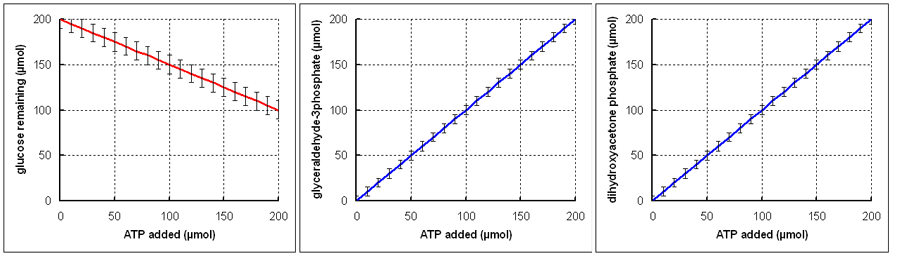
What conclusions can you draw from these results?
These graphs show that there is a requirement for 2 mol of ATP for each mol of glucose metabolised, and that 1 mol each of glyceraldehyde 3-phpsphate and dihydroxyacetone phosphate is formed per mol of glucose. These results thus confirm the conclusions drawn from the first experiment with dialysed muscle supernatant.
Like red blood cells, muscle preparations that are incubated anaerobically normally produce lactate from glucose.
Why do you think it may be that the dialysed muscle preparation did not form lactate?
The fact that the dialysed muscle preparation did not produce any lactate, although muscle incubated under anaerobic conditions forms lactate from glucose, suggests that there may be a low molecular weight compound that is required for the full pathway of glucose metabolism, and this has been lost in dialysis. A classical way of testing this hypothesis is to boil a sample of the tissue preparation before dialysis, centrifuge it to remove denatured protein, then add some of the supernatant to the incubation mixture. This preparation is commonly known as a kochsaft (from the German, meaning literally cooking or cooked juice).
A series of incubations was set up containing both the dialysed muscle preparation and either buffer or the kochsaft from boiled (but undialysed) muscle preparation, together with:
200 µmol glucose
200 µmol ATP
200 µmol ADP
200 µmol sodium phosphate
After incubation at 30C for 30 min, incubations were stopped by adding trichloroacetic acid to denature proteins, centrifuged and the supernatant was neutralised with sodium hydroxide. Aliquots of the supernatant were then subjected to high pressure liquid chromatography to measure glucose, lactate, ATP and ADP. The following results were obtained:
| control (+ buffer) | + kochsaft | |
| glucose | 100 |
100 |
| lactate | 0 |
80 |
| ATP | 0 |
400 |
| ADP | 300 |
0 |