Metabolism
on-line - the virtual tutorial room
copyright © 2008 - 2015 David A Bender
Weight loss in a patient with advanced cancer
AB is an 80 year old man who has metastatic cancer of the pancreas. He is 170 cm tall, and weighs 49 kg. He has lost 2 kg in body weight over the last 4 weeks - the condition of cancer cachexia.
What is his body mass index, and how would you classify it?
height ^2 = 1.7 x 1.7 = 2.89
BMI = weight / (height m^2) = 49 / 2.89 = 16.96
He is undernourished
His mean skinfold thickness is 1.9 mm, suggesting that he has negligible reserves of adipose tissue, and he shows considerable wasting of muscle, so we can assume that most of his weight loss is muscle.
The composition of muscle is:
79% water
17% protein (at 17 kJ /gram)
3% fat (at 37 kJ /gram)
What was his overall energy deficit over the last 4 weeks?
1 kg muscle =
170 g protein at 17 kJ /g = 2890 kJ
30 g fat at 37 kJ /g = 1110 kJ
Total = 4000 kJ = 4 MJ / kg muscle loss
He has lost 2 kg over 4 weeks = 8 MJ total deficit = 8000/28 = 286 kJ /day
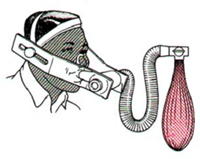 For his
age and weight we would expect his basal metabolic rate (BMR) to be between
4.7 - 4.9 MJ /day. His oxygen consumption at rest was measured and was found
to be 11.2 L /hour.
For his
age and weight we would expect his basal metabolic rate (BMR) to be between
4.7 - 4.9 MJ /day. His oxygen consumption at rest was measured and was found
to be 11.2 L /hour.
Regardless of the fuel being consumed, 1 L of oxygen is equivalent to energy expenditure of 20 kJ.
What is his BMR now?
11.2 L oxygen x 20 kJ = 224 kJ /hour x 24 = 5.376 kJ = 5.4 MJ /day
This means that his BMR is 0.6 MJ /day or 12.5% higher than the average for a man of his age and weight.
We need to try to explain why his BMR is so much higher than would be expected.
A blood sample was taken one morning before breakfast, and the following results were obtained:
AB |
reference range |
|
| glucose, mmol /L | 3.1 |
3.0 - 5.5 |
| lactate, mmol /L | 2.5 |
0.4 - 0.6 |
| pyruvate, mmol /L | 0.05 |
0.04 - 0.06 |
| standard liver function tests | normal |
- |
What conclusions can you draw from these results?
His plasma glucose is low, but within the reference range.
He is slightly acidotic, with an elevated plasma lactate, and normal pyruvate.
Under what conditions might you expect to see a moderately elevated plasma lactate concentration?
As we saw in the exercise breathless after sprinting, an elevated plasma lactate is associated with vigorous physical activity. Although 2.5 mmol /L is not as high as seen in WS after a 100 m sprint, it is within the range you would expect for someone who had just climbed 2 or 3 flights of stairs. However, AB has not climbed any stairs, and indeed the blood sample was taken while he was sitting up in bed - and therefore more or less at rest.
Apart from muscle, which other tissue normally produces lactate?
Red blood cells. They have no mitochondria and are therefore only capable of anaerobic glycolysis. They take up glucose from the bloodstream and put out lactate, which is used in the liver as a substrate for gluconeogenesis.
Since the lactate has obviously not come from muscle as a result of physical activity, and there is no reason to believe that AB's red blood cells are producing significantly more lactate than normal, why might his plasma lactate be so high?
One possibility is that his liver is not clearing the lactate produced by red blood cells, so that the plasma concentration is elevated. However, we are told that the results of "standard liver function tests" were normal, so this is unlikely.
This leaves the most likely source of lactate as the tumour and its metastases. There is a great deal of evidence that many tumours have impaired oxidative metabolism and are relatively anaerobic, producing a significant amount of lactate, which is then used for gluconeogenesis in the liver.
Such cycling between anaerobic glycolysis in the tumour and gluconeogenesis in the liver would explain a considerable part of his increased basal metabolic rate. As we saw in the exercise breathless after sprinting, there is a cost of 6 x ATP for each 2 mol of lactate converted to glucose in the liver, and this has to be provided by additional oxidative metabolism in the liver. (We will come back to AB in later exercises, when we we will consider other metabolic problems associated with advanced cancer).
In order to test this hypothesis that AB's problem is increased cycling between anaerobic glycolysis in the tumour and gluconeogenesis in the liver, AB was given an intravenous infusion of [13C-1]glucose, and a blood sample was taken an hour later. 13C is the stable isotope of carbon, which can be detected by mass spectrometry or its nuclear magnetic resonance (NMR) signal. Using 13C-NMR it is possible not only to determine the amount of 13C present, but also to determine which carbon atoms are labelled.